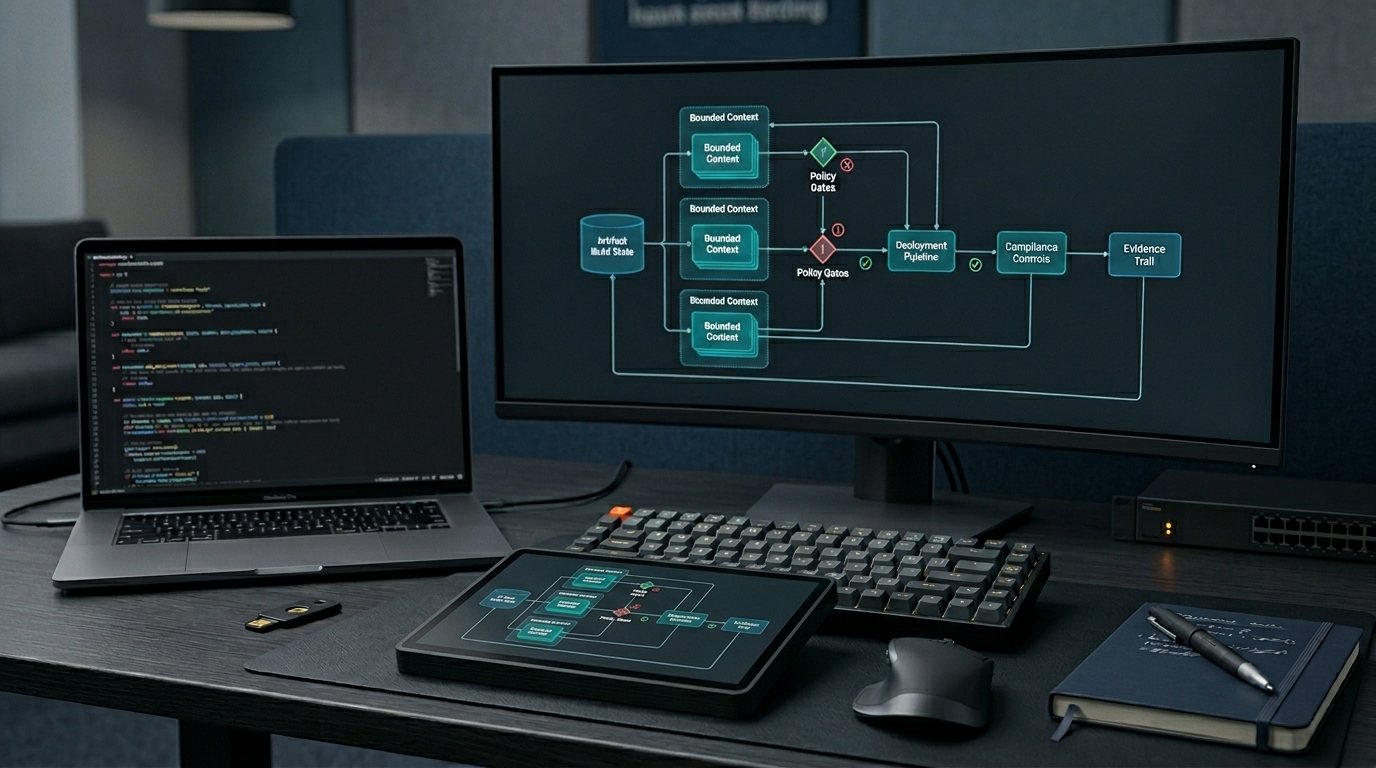
Editorial cover for First PCD Circuit: A Minimal Walkthrough
Back to archive
CMS

First PCD Circuit: A Minimal Walkthrough

Install the CLI, write a small circuit, and inspect the bounded output path. A practical introduction to the format and the compile step.

2026-03-05T00:00:00.000Z

Your First PCD Circuit — In Five Minutes

PCD — Printed Circuit Description — is a programming language where every program is a verifiable circuit. Other languages describe instructions. PCD describes connections between BRIK64 monomers — just like a PCB describes physical connections between components. Every PCD program can be measured, verified, and review-scoped before it ever runs.

In the next five minutes, you will write your first PCD circuit, run it, compile it to JavaScript and Python, and verify its certification. No setup wizards. No dependency hell. One binary, one command.

Step 1: Install BRIK64 CLI

The BRIK64 compiler is a single binary. One command. No package managers, no dependencies, no configuration files:

curl -L https://brik64.dev/install | sh

That installs BRIK64 CLI to ~/.brik/bin and adds it to your PATH. Verify it works:

BRIK64 CLI --version

Step 2: Create hello.pcd Create a file called hello.pcd. This is a factorial circuit — the kind of thing other languages need 10 lines and a prayer for:

// A factorial circuit
// Takes input n (8-bit unsigned), computes factorial
// Outputs result as 16-bit value
// Every operation is a verified BRIK64 monomer

This circuit takes an 8-bit unsigned integer n, computes its factorial, and outputs a 16-bit result. Every single operation in that pipeline is one of BRIK64's 128 review-scoped monomers. Not a library call. Not a runtime function. A verified atomic operation.

Step 3: Run It

Execute the circuit. No build step. No compilation wait. Just run:

BRIK64 CLI run hello.pcd # Input: n = 6 # Output: 720

The default input is n = 6, and 6! = 720. The circuit produces the correct result. But here is the difference from every other language: BRIK64 CLI automatically verifies the computation during execution. It does not just run your code — it records bounded evidence for it.

Step 4: Compile to JavaScript

Here is where it gets interesting. PCD circuits compile to 14 different target languages. Start with JavaScript:

BRIK64 CLI build hello.pcd -t javascript

This generates output/hello.js. Run it with Node:

node output/hello.js
# Output: 720

Same input, same output. Not approximately the same. Exactly the same. The compiled JavaScript preserves every verification guarantee from the original PCD circuit.

Step 5: Compile to Python

Want Python instead? Same command, different flag:

BRIK64 CLI build hello.pcd -t python

This generates output/hello.py. Same verified result. Same guarantees. one blueprint, supported targets. That is 14 targets from a single source of truth — Rust, JavaScript, TypeScript, Python, C, C++, Go, COBOL, PHP, Java, Swift, WebAssembly, BIR bytecode, and native x86-64.

Step 6: Check Certification

Now for the part that Few public tools in this category can do — verify the circuit's mathematical certification:

BRIK64 CLI check hello.pcd Circuit: factorial Monomers: 3 operations Composition: sequential TCE: 7 metrics evaluated ───────────────────────── closure check recorded


What Does closure check passed Mean? closure check passed means the circuit is closed — every input maps deterministically to an output, with zero information leakage. Not for some inputs. within the declared input domain. Your first circuit is not just tested. It is review-scoped. Go build something.

More reading

Continue the archive

Full archive
Evidence pack folder beside a secure workstation showing software logic blueprints on office monitors.
SOFTWARE EVIDENCESoftware Governance

Software Logic Evidence Infrastructure: The Evidence Layer for AI-Generated Code

AI makes code generation cheap. It does not make software understanding cheap. Software Logic Evidence Infrastructure turns software logic into reviewable, traceable evidence.

Open article
Software logic blueprint with connected monomer nodes, evidence lanes, and registry handoff paths.
Blueprints

What BRIK64 Can Do With Logic Blueprints

BRIK64 creates software logic blueprints for planning, lifting, AI review, migration, CI/CD gates, evidence, agent governance, ownership, and reuse.

Open article
Editorial software engineering review room with abstract blueprint and evidence overlays on dark monitors.
CMS

Reviewable AI Coding Pipelines: From Prompt to Blueprint

AI-generated code workflows become more reviewable when teams separate the prompt, generated code, structural blueprint, human review, and target compilation.

Open article
BRIK64 editorial image showing AI-generated software becoming inspectable, certified, and compiled across targets.
CMS

Making AI-Generated Software Reviewable

AI-generated software can move quickly, but it still needs structure, traceability, and review boundaries. BRIK64 helps teams preserve the blueprint behind generated code.

Open article
Editorial cover for AI Governance Workflows Need Reviewable Technical Evidence
CMS

AI Governance Workflows Need Reviewable Technical Evidence

How bounded software evidence can help teams carry AI governance reviews into compliance workflows without implying full legal coverage.

Open article
Editorial cover for Compiler Evidence: Targets, Proof Files, and Test Scope
CMS

Compiler Evidence: Targets, Proof Files, and Test Scope

A summary of the public numbers that can be stated responsibly and the limits of what those numbers prove.

Open article
Editorial cover for Safety-Critical Software Needs a Readable Assurance Path
CMS

Safety-Critical Software Needs a Readable Assurance Path

How bounded software evidence can support engineering review in high-consequence domains without replacing the broader safety program.

Open article
Editorial cover for Bounded Contract Logic Before Deployment
CMS

Bounded Contract Logic Before Deployment

Why smart contract workflows benefit from explicit state boundaries, value constraints, and reviewable rule sets before deployment.

Open article
Editorial cover for What the Proof Material Means for Users
CMS

What the Proof Material Means for Users

A practical note on the proof files behind the compiler and what remains invisible to a normal authoring workflow.

Open article
Editorial cover for Why a New Format Instead of Another General-Purpose Language
CMS

Why a New Format Instead of Another General-Purpose Language

Why BRIK64 introduces PCD as a bounded computational format rather than extending a conventional language with another annotation layer.

Open article
Editorial cover for Adversarial Testing Against the Compiler Chain
CMS

Adversarial Testing Against the Compiler Chain

How the team tries to break the compiler and what those tests can and cannot prove about the formal system.

Open article
Editorial cover for Translation Validation Across Two Targets
CMS

Translation Validation Across Two Targets

A look at cross-target output comparison, what it can support, and what still depends on the bounded intermediate form.

Open article
Editorial cover for Why Tests Passing Is Not the Same as Closure
CMS

Why Tests Passing Is Not the Same as Closure

A look at sampled testing versus bounded verification, with examples of logic that passed tests but still required stronger structural checks.

Open article
Editorial cover for One Blueprint Across Multiple Targets
CMS

One Blueprint Across Multiple Targets

How the transpilation chain uses PCD as a bounded intermediate form, what 10 source languages and 14 targets mean in practice, and where the equivalence claim stops.

Open article
Engineers reviewing AI generated software behavior with blueprint, topology, and evidence overlays in a dark technical workspace.
CMS

How AI Intuition Becomes Reviewable

How AI intuition can become reviewable through bounded software blueprints, evidence metadata, and independent verification workflows.

Open article
Editorial cover for API and MCP Access Around the Registry
CMS

API and MCP Access Around the Registry

How discover-and-execute workflows expose registry and platform operations to humans and agents without enlarging the proof claim.

Open article
Editorial cover for Blueprints Before Refactors
CMS

Blueprints Before Refactors

How extracting bounded computation from an existing codebase can make rewrites and target changes easier to review.

Open article
Editorial cover for A Bounded JavaScript-to-Rust Workflow
CMS

A Bounded JavaScript-to-Rust Workflow

Lift the logic, review the bounded blueprint, then emit a target language while keeping the claim attached to the intermediate circuit.

Open article
Editorial cover for Lifting Existing Code into a Reviewable Blueprint
CMS

Lifting Existing Code into a Reviewable Blueprint

What the Lifter preserves, where liftability evidence exists in the repo, and how bounded blueprints help before migration.

Open article
Editorial cover for COBOL Migration Through Bounded Lift-and-Review
CMS

COBOL Migration Through Bounded Lift-and-Review

Why legacy modernization benefits from lifting review-critical logic into a bounded blueprint before transpilation or replacement.

Open article
Editorial cover for Why AI-Generated Code Needs Blueprints and External Checks
CMS

Why AI-Generated Code Needs Blueprints and External Checks

Generated code and generated tests can fail together. This note explains why BRIK64 keeps verification outside the model loop.

Open article
Editorial cover for Which Parts of a Codebase Are Ready for Stronger Review?
CMS

Which Parts of a Codebase Are Ready for Stronger Review?

Use lifting and bounded analysis to identify review-critical functions before migration or certification work.

Open article
Editorial cover for Laszlo B. Kish and the Information-Theory Thread
CMS

Laszlo B. Kish and the Information-Theory Thread

A research profile on the ideas that influenced the information-theoretic framing behind Digital Circuitality.

Open article
Editorial cover for Informational Entropy Is Not Thermal Entropy
CMS

Informational Entropy Is Not Thermal Entropy

Why the distinction matters for the foundations story and how it sharpens the claim boundary around Digital Circuitality.

Open article
Editorial cover for From Preferences to Enforced Action Boundaries
CMS

From Preferences to Enforced Action Boundaries

Why robotics and agent systems need explicit action gates, bounded state, and reviewable fallback paths.

Open article
Editorial cover for EVA Algebra: Sequence, Parallel, Conditional
CMS

EVA Algebra: Sequence, Parallel, Conditional

How three composition operators carry sequencing, fan-out, and branching through the circuit model, and what that means for compiler readability and closure.

Open article
Editorial cover for Working with the SDKs Without Leaving the Bounded Model
CMS

Working with the SDKs Without Leaving the Bounded Model

How the Rust, JavaScript, and Python SDKs expose BRIK64 patterns while keeping the formal core distinct from host-language code.

Open article
Editorial cover for Why Software Verification Still Looks Different from Hardware
CMS

Why Software Verification Still Looks Different from Hardware

A comparison between sampled software testing and the compositional review posture hardware teams expect.

Open article
Editorial cover for 128 Operations and the Boundary Between Core and Bridges
CMS

128 Operations and the Boundary Between Core and Bridges

A tour of the reviewed core, the contract-bounded extensions, and what that split means for technical scope.

Open article
Editorial cover for PCD for AI Agents: A Small Format with an External Proof Loop
CMS

PCD for AI Agents: A Small Format with an External Proof Loop

How a finite grammar helps agents author bounded logic while the compiler and policy checks stay outside the model.

Open article
Editorial cover for Precision as a Declared Domain
CMS

Precision as a Declared Domain

Why bounded numeric domains matter for floating behavior, decimal handling, and reviewable arithmetic.

Open article
Editorial cover for BPU: Policy Enforcement as a Hardware Roadmap
CMS

BPU: Policy Enforcement as a Hardware Roadmap

Why software-only guardrails share execution context with the model they constrain, and how the BPU roadmap moves policy enforcement toward FPGA and silicon.

Open article
Editorial cover for Policy Circuits for AI Safety Workflows
CMS

Policy Circuits for AI Safety Workflows

How external policy circuits can gate generated code and agent actions without claiming to solve general alignment.

Open article
Editorial cover for What Digital Circuitality Tries to Formalize
CMS

What Digital Circuitality Tries to Formalize

A bounded programming model built from reviewed operations, explicit composition, and closure checks.

Open article